
PRESENCE
KNOW NATION's Educational Framework for Human Development
WHY THIS WORK EXISTS
Education has never asked more of young people.
Students today are expected to think critically, collaborate across differences, adapt to uncertainty, communicate with clarity, remain emotionally and intellectually resilient, and engage with a world shaped by technological, ecological, cultural, and political complexity.
Yet, many of the human capacities required to meet this reality remain implicit within education.
Students are trained to think, analyse, write, speak, calculate, research, and perform. They are often less systematically supported in developing the embodied and relational capacities that allow those abilities to remain available under pressure: attention, presence, perception, imagination, coordination, responsiveness, ethical awareness, and the ability to remain connected to oneself and others while navigating complexity.
PRESENCE emerges from this observation.
It proposes that learning is not only cognitive. It is also perceptual, relational, creative, ethical, and embodied. The question is no longer only how students acquire knowledge, but how they remain attentive, imaginative, responsive, and fully human while using that knowledge in increasingly demanding environments.
This work is not conceived as an alternative to academic rigor. It is designed to support the human conditions through which rigor, creativity, collaboration, and performance can be sustained over time.
THE EDUCATIONAL OPPORTUNITY
Across schools internationally, a new educational question is becoming visible. Academic excellence remains essential. But excellence alone is no longer enough if students cannot sustain clarity, judgment, attention, and meaningful participation under conditions of increasing pressure and complexity.
The capacities now required of young people extend beyond subject mastery. Students must be able to:
- sustain attention during long sequences of cognitive work
- collaborate across roles, perspectives, and disciplines
- move between individual focus and collective responsibility
- remain creative under uncertainty
- communicate under exposure
- respond ethically within complex social situations
- recover, reorient, and continue without losing clarity
- engage with knowledge not only conceptually, but through lived experience
Presence strengthens the relationship between attention, movement, perception, imagination, collaboration, and learning. It offers schools a way to develop the human capacities that support academic excellence without reducing education to performance alone.
THE FRAMEWORK
Presence is a developmental framework for integrating body, attention, perception, creativity, and collaboration within education.
It is based on the understanding that students do not learn only through information. They learn through experience, relationship, rhythm, attention, movement, spatial awareness, decision-making, and interaction with others.
The framework develops four interrelated dimensions:
Sustained Engagement
The capacity to remain attentive, available, and active across extended periods of learning.
Collaborative Intelligence
The capacity to listen, respond, adapt, and remain aware of the whole while acting within a distinct role.
Creative Responsiveness
The capacity to imagine, experiment, take creative risks, and respond to changing conditions in real time.
Human Performance Under Complexity
The capacity to maintain clarity, judgment, participation, and presence within demanding intellectual, social, and creative environments.
These dimensions are developed through classroom practices, interdisciplinary intensives, teacher integration, and collaborative creation.
The aim is not to introduce another subject. The aim is to strengthen the conditions through which learning itself becomes more integrated, perceptive, creative, and human.
HOW THE WORK UNFOLDS
Presence can be adapted to different educational environments, age groups, cultural contexts, and institutional priorities. It may unfold through three complementary modes:
01 Continuous Classroom Practices
Short practices are embedded within moments already present
in the school day: the beginning of lessons, transitions between subjects, preparation for presentations, long periods of concentration, collaborative work, and moments where attention begins to fragment.
These practices may include:
- brief attentional resets before complex tasks
- collective reorientation during transitions
- movement-based coordination exercises
- breathing and posture adjustments before presentations or evaluations
- collaborative exercises supporting group awareness and responsiveness
The intention is not interruption. It is to support continuity within learning itself. Over time, these practices help students sustain participation, transition more fluidly between tasks, and remain clearer and more responsive under cognitive demand.
02 Interdisciplinary Collaborative Intensives
Focused intensives allow students to work across movement, language, performance, reflection, music, design, architecture, communication, and collaborative composition. These environments require:
- shared decision-making
- real-time adaptation
- verbal and non-verbal coordination
- collective timing
- responsiveness to others
- creative risk-taking
- ethical and relational responsibility
Students experience complexity directly rather than only analysing it conceptually. In this context, imagination, empathy, listening, judgment, and collaboration become practiced forms of learning.
03 Teacher Integration
For the work to be sustainable, it must be carried within the school environment itself. Teacher integration may include:
- concise practical formats
- observation and reflection
- classroom practices for transitions and attention
- approaches to sustaining participation and group coherence
- shared strategies adaptable to different pedagogical styles
The aim is not standardization. The aim is to develop shared practices that can be carried by teachers in ways aligned with their own classroom realities.
Context within Creating Culture
Presence strengthens capacities that become increasingly
important in advanced learning environments.Observable
educational outcomes may include:
- greater continuity of participation in extended academic work
- increased confidence in discussion, presentation, and collaborative settings
- stronger responsiveness within group processes
- greater adaptability under changing conditions
- increased autonomy in complex or open-ended tasks
- stronger creative participation and willingness to contribute
- more stable group attention
- reduced fragmentation during transitions
- increased participation from students who tend to withdraw under pressure
- greater clarity during demanding periods of academic work
- stronger collective awareness during interdisciplinary collaboration
The work also supports deeper human formation. Students develop not only performance capacities, but also curiosity, imagination, ethical awareness, relational intelligence, sensory perception, and meaningful participation within collective learning environments.
FOUNDATIONAL WORK
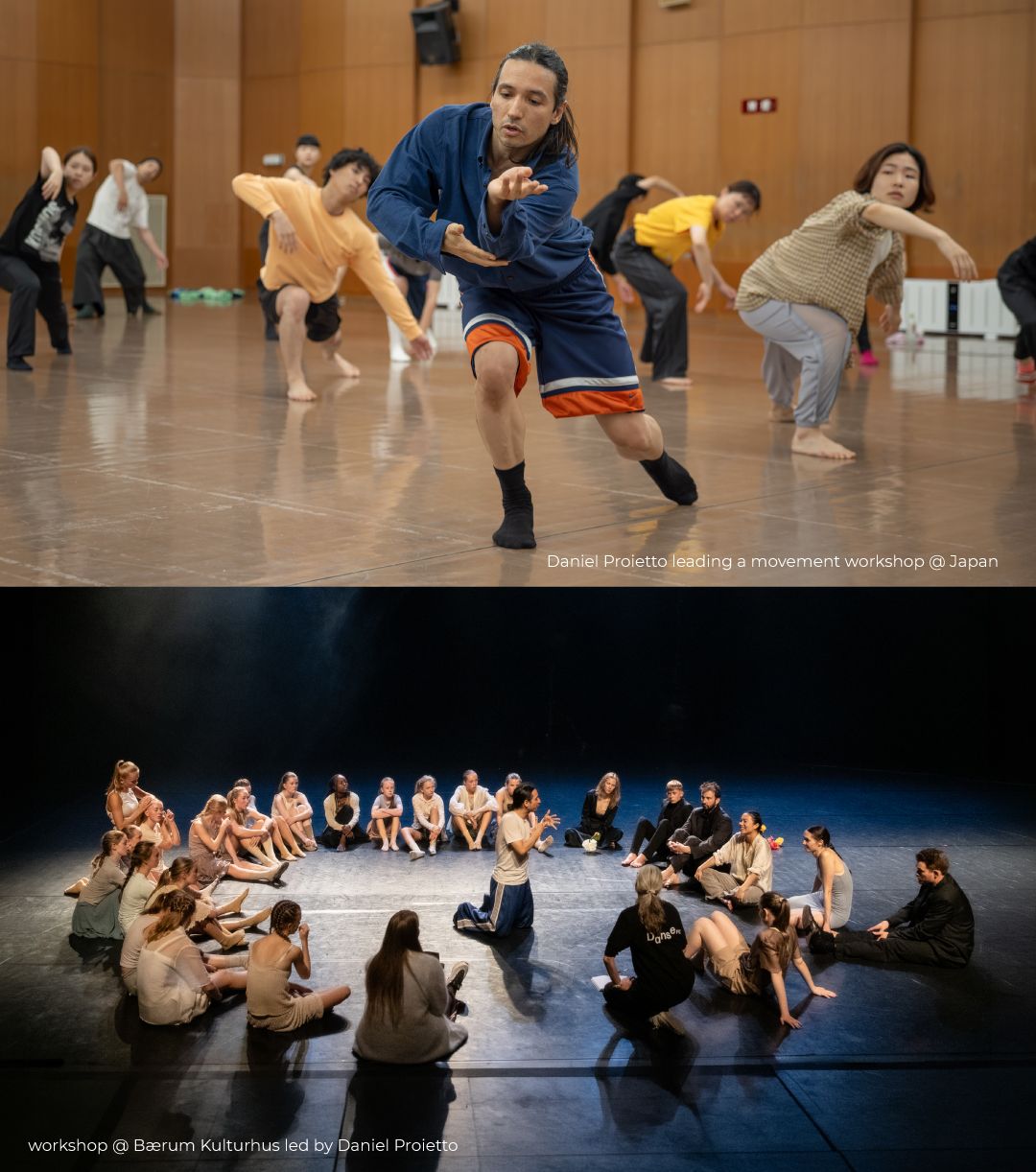
Presence emerges from a long-term body of research and practice developed by Daniel Proietto through Know Nation.
This work is grounded in two foundational strands: The Fundamentals of Movement and Embodied Practices.
THE FUNDAMENTALS OF MOVEMENT
Developed over many years of artistic practice, teaching, and research, The Fundamentals of Movement explores movement not as technical skill alone, but as a fundamental language of human perception, organization, and learning.
Rather than focusing on dance as an artistic discipline, the framework investigates principles that underlie all human movement: attention, alignment, coordination, breathing, rhythm, balance, adaptability, and the continuous relationship between perception and action.
Originally emerging from Daniel Proietto’s work with dancers and performers, the framework has progressively expanded into broader educational contexts, where these same principles support learning, communication, creativity, wellbeing, and collaborative engagement.
EMBODIED PRACTICES
Embodied Practices is not simply a collection of somatic techniques - it is an orientation to practice. Developed through interdisciplinary research and artistic practice, it explores movement as a way of reconnecting with inherited ways of knowing and rediscovering the intelligence of the body.
Rather than training the body toward performance or achievement, the framework invites movement as a practice of listening - to breath, weight, effort, perception, and internal organisation. Through this process, participants deepen attention, presence, and their capacity to engage themselves and others with greater sensitivity and coherence.
Drawing from artistic practice while informed by contemporary research in education, neuroscience, embodied cognition, contemplative practice, somatic approaches, and collaborative learning, the framework supports more integrated, perceptive, creative, and human ways of learning.
CURRENT DEVELOPMENTS
Sensing Space
The continuing development of this work extends beyond a single school.
Through Sensing Space, Know Nation is co-developing a broader educational program with the Snøhetta Foundation and educational partners in Norway. The program explores how architecture, movement, creativity, ecology, perception, and collaborative learning can become integrated within public education.
Rather than transferring artistic practices into schools, Sensing Space investigates how interdisciplinary learning environments can cultivate curiosity, imagination, ecological awareness, collaborative intelligence, and embodied understanding through direct experience.
The initiative will support the development of educational programs for public schools in Norway and forms an important next step in Know Nation’s long-term research into the future of learning.
Together, the work with École Jeannine Manuel and Sensing Space establishes Presence as an educational framework with relevance across both high-performance international school environments and public education contexts.
PARTNERSHIP OPPORTUNITIES
Presence is designed to be adaptable across different educational and cultural contexts.
KNOW NATION is seeking partnerships with schools, foundations, universities, cultural institutions, public agencies, and donors interested in supporting new models of human learning, creativity, and collaboration.
Possible forms of partnership include:
- pilot programs in schools
- interdisciplinary student intensives
- teacher development programs
- public education initiatives
- research and evaluation partnerships
- cultural and artistic collaborations
- donor-supported access programs
- international educational partnerships
- curriculum development and publication
The work can be adapted to:
- international schools
- public schools
- universities
- cultural institutions
- teacher education programs
- youth development initiatives
- arts and education foundations
- philanthropic programs supporting education, creativity, and human development
At its core, Presence asks a simple but urgent question:
How can education cultivate the human capacities required not only to succeed, but to remain perceptive, creative, collaborative, and fully human in a world of increasing complexity?